
Build a Digital Twin of Every Patient Journey with PX
Transform patient journeys with PX: unlock insights from fragmented health data effortlessly!

Hospitals and research teams sit on massive volumes of fragmented data — EHRs, lab results, procedures, medications — yet struggle to answer even a seemingly basic question like:
"What actually happened to this patient and in what order?"
Raw health records don't reflect patient pathways. These have to be inferred across scattered systems, inconsistent formats, and complex medical logic. And in this high-stakes, regulated domain, transparency and explainability are not optional.
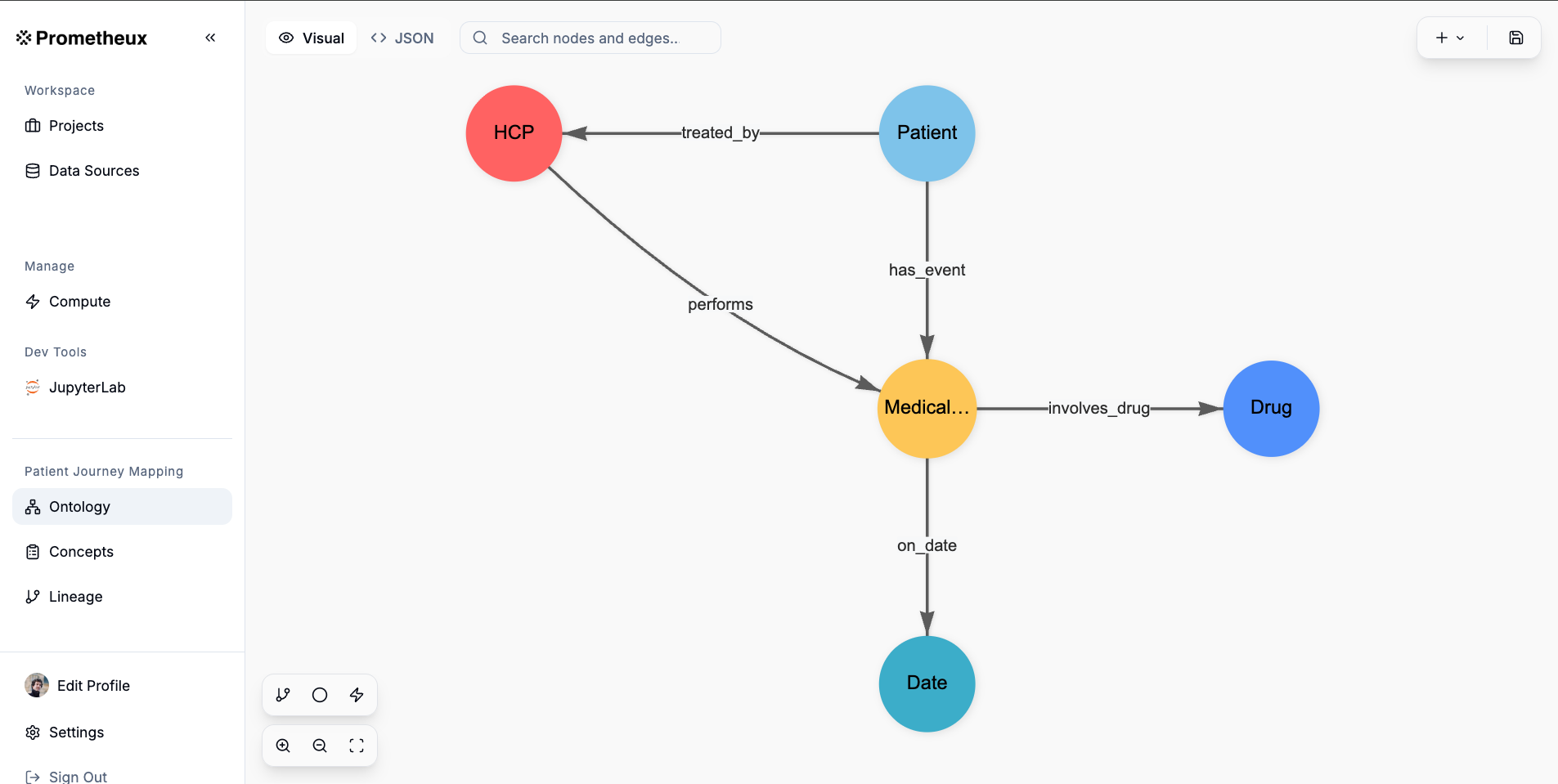
Organizations choose Prometheux to map patient pathways simply and deterministically, creating a unified ontology across all their data, wherever it lives. Teams can then explore patient journeys at scale, across millions of datapoints, with full lineage down to each individual patient ID, unlocking true patient-centric, personalized care.
The Challenge
Healthcare organizations need to answer seemingly simple questions:
- How do real patients actually move through diagnosis, treatment, and follow-up?
- How closely do real-world journeys align with official clinical pathways?
- How do pathways and outcomes vary across subgroups?
- What impact do specific treatment choices or drug combinations have?
But today, the answers are hidden beneath fragmented data and highly complex analytics:
- Reconstructing pathways involves stitching together admissions, procedures, diagnoses, prescriptions, and multiple coding systems, requiring complex joins across inconsistent schemas.
- Medical coding is very complex, with thousands of overlapping ICD and SNOMED concepts, making even simple classification tasks manual and non-reusable.
- Patient pathways involve multi-step sequences (symptoms → imaging → referral → diagnosis → treatment), requiring recursive logic that traditional SQL cannot handle natively.
- Clinicians need explainability. Black-box ML and AI models alone cannot show deterministically why a patient belongs in a cohort or how an inference was made.
Even defining what "counts" as a procedure requires fragile, one-off pipelines that can take significant time and effort to build.
The Solution
PX eliminates the need for complicated, custom pipelines. Instead, teams express expert medical domain logic once as reusable concepts and rules, creating a live, unified ontology of all the data in an organization.
First, PX connects directly to all your data, wherever it lives, from admissions, diagnoses, procedures and other EHR tables to medical codes such as ICD and SNOMED, and more. This ontology creates semantically consistent definitions of diseases, procedures, anatomy and the relationships between them, without needing manual code list maintenance.
With just 2-3 simple lines, teams can:
- Merge admissions and procedures into unified events
- Identify primary procedures automatically
- Group thousands of raw codes into intuitive categories (e.g., Surgery, Chemotherapy, Imaging)
- Retrieve all related clinical codes by defining a concept once
What once required weeks of work in Python, SQL, PySpark, and more, becomes largely automated and fully traceable.
From this ontology, teams can reconstruct complete patient journeys. A few declarative rules replace hundreds of lines of complex SQL joins to create chronological sequences across millions of records.
With PX, teams can run high-performance recursive queries to trace pathways from key events — such as a first surgery or chemotherapy — back through the most common preceding patterns. Pathway summaries like Imaging → Surgery → Chemotherapy are inferred automatically, adapting to variable-length histories while preserving full lineage to the original clinical events for traceability.
Every inference, whether a cohort definition, pathway pattern, or event classification, comes with a complete reasoning trace, enabling clinical trust and regulatory readiness.
With a clearer view of patient journeys, teams can run queries across millions of data points in seconds, like:
- "Find all patients whose symptoms progressed to diagnosis X within Y days"
- "Which diagnoses typically precede condition X?"
- "Which procedures commonly occur before treatment Y?"
- "Which therapies follow drug A within 30 days?"
- "Which providers are most involved in the steps leading to treatment initiation?"
- "How do journeys differ between patients who responded vs. did not respond to treatment?"
- "Why was the patient assigned to this cohort?"
All backed by deterministic logic, semantic consistency and value-level lineage.
Looking Ahead
With Prometheux, patient journeys become a live, reusable knowledge layer rather than manual one-off analyses. Organizations can extend their ontology to new conditions, specialties, or data sources without rewriting complex pipelines.
Prometheux becomes the shared semantic and data layer for:
- Real-world evidence
- Clinical research
- Quality and safety analytics
- Care pathway optimization
- Personalized care programs
- LLM-based agents grounded in deterministic clinical logic
Teams gain a scalable knowledge foundation that ensures every analysis, whether human or AI, operates on transparent, explainable, clinically valid reasoning.
Related Posts
Perspectives on our customers, future of data, AI, and ontologies.

Unlock 40% more revenue with AI-powered personalized product recommendations!

Transforming credit risk analysis from 17 minutes to 5 seconds with Prometheux's innovative automation.
Unlock cloud flexibility with Prometheux: run compute anywhere, effortlessly switch providers!
