
How Retailers Boost Revenue with PX-Powered Personalized Recommendations
Unlock 40% more revenue with AI-powered personalized product recommendations!

Bad search results and irrelevant product recommendations lead to lost revenue. With AI taking over traditional search, shoppers now expect the first few results to be deeply relevant and, most importantly, aligned with their intent.
Shoppers who search for products convert about 2.5× more than those who just browse. However, recommendations based on RAG / vector search approaches often miss the products shoppers actually want, leaving revenue on the table.
Large retailers choose Prometheux (PX) to boost revenue with smarter product recommendations that better capture customer intent, navigating thousands of distinct attributes across millions of SKUs, turning their existing data into better answers via their very own ontology.
The Challenge
Traditional search approaches are blind to the deeper structure and semantic relationships implicit in a large retailer's data stack — product attributes, materials, use-cases, users, communities, and more. As catalogs expand and data scatters across systems, embeddings alone fail to recover this implicit yet precious domain knowledge, causing weaker relevance in product recommendations.
Many retailers face the same challenges:
- Product data with millions of attributes but no understanding of the connections between them
- Cross-category blindness that misses relevant recommendations across the product catalog
- Poor similarity-based recommendations, where questions like "find something similar but cheaper" returned products that "sounded" alike but weren't actually relevant
- Limited understanding of customer intent, for queries like "What do I need for a beginner photography kit?"
- Result overload, with hundreds of loosely relevant items and no unique way of prioritizing
As a result, recommendation engines operate on incomplete understanding, leading to missed products, incomplete recommendations, empty answers, and ultimately, lost revenue.
The Solution
With PX, retailers boost revenue with highly personalized recommendations by building a domain ontology directly connected to their live data.
Teams begin by connecting product catalogs, taxonomies, attributes, user history, and more, across their existing databases, warehouses and APIs in seconds, without moving or duplicating any data. Organizations can choose whether to deploy on PX cloud or on-premise.
Next, you define reusable business concepts and rules as nodes and relationships, creating an ontology unique to their organization. This ontology acts as a structured semantic backbone that can perform multi-hop reasoning, infer intent, and surface products traditional approaches miss.
Product names and attributes are embedded and then attached to the ontology, creating an enhanced vector search + PX ontology approach.
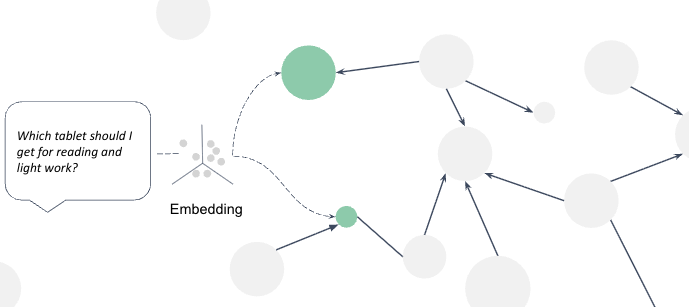
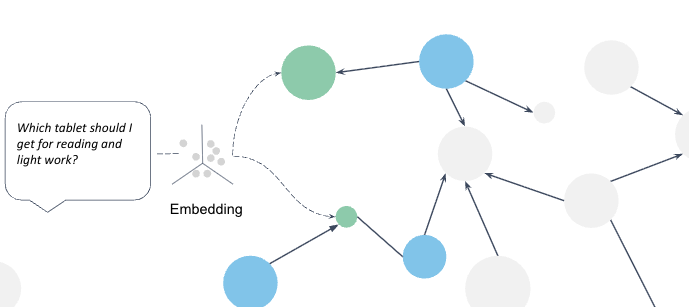
The PX recommendation engine ranks and returns the top results, ensuring all of the most relevant products are recommended to the customer. The customer ultimately receives the most relevant, high-propensity products, maximizing conversion and ensuring that the items they are most likely to buy are always surfaced.
The Result
Retailers using Prometheux saw +40% lift in the relevance of product recommendations by enhancing traditional vector-search based approaches with the PX ontology.
In practice, this means the ontology consistently surfaced the most relevant products that vector search alone had failed to detect for nearly half of the questions asked.
Industry benchmarks make clear why this uplift matters:
- A 28.7% improvement in recommendation quality helped Etsy increase overall site conversion by 2.63%.
- Walmart saw a 0.54% rise in add-to-cart actions following an 18% improvement in recommendation relevance.
- Target cut "no-result" searches in half after a 20% improvement in recommendation quality.
With PX, retailers can achieve these results in days, rather than months of costly internal development, migrations and complex pipelines.
Looking Ahead
Retailers are only scratching the surface of what becomes possible when product data, customer context, and cloud infrastructure behave like one coherent system.
As retailers push toward richer personalization, Prometheux sets the new default: a single semantic control plane where data and meaning stay perfectly aligned. What started as better product recommendations is evolving into something far more powerful: unified business intelligence that spans every side of the business.
The retailers moving fastest aren't just improving search, they're collapsing the traditional barriers between their data teams and business units into one intelligent system. They're turning their entire data ecosystem into a competitive advantage: a unified understanding of the business that humans and AI rely on to make every decision faster and more accurate.
Related Posts
Perspectives on our customers, future of data, AI, and ontologies.

Transforming credit risk analysis from 17 minutes to 5 seconds with Prometheux's innovative automation.

Transform patient journeys with PX: unlock insights from fragmented health data effortlessly!
Unlock cloud flexibility with Prometheux: run compute anywhere, effortlessly switch providers!
